• Home
  • About Alex Wild
  • Articles
  • Galleries
  • Myrmecology News

Myrmecos Blog

the little things matter

Feeds:
Posts
Comments
« Ants of Archbold
Is blogging bad for my academic career? »

An Ant Lion in Action

June 23, 2009 by myrmecos

caption

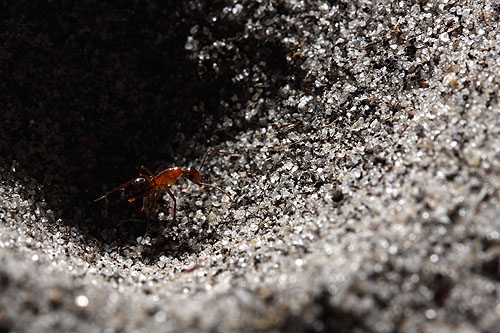
An ant, climbing from the pit of a predatory ant lion.

car

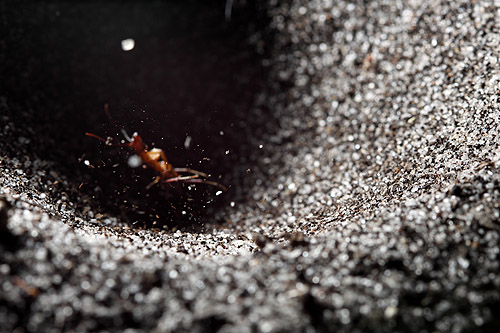
The predator, buried in sand at the base of the pit, hurls a volley of debris towards its target.
caption

Caught in the falling sand, the ant slides back into the pit.

caption

The ant tries to escape, and again the unseen predator hurls a load of sand into her path.

cap

No matter which way the ant turns, the ant lion adjusts its aim, sending up clouds of sand and preventing the ant from gaining traction on the steep walls of the pit.
cap

In the end, the ant lion wins.

cap

A tight crop of the previous image shows the jaws of the ant lion reaching up around the waist of the ant.

Portrait

Removed from its pit, the predator is revealed to be little more than a set of jaws attached to an enormous stomach. These fierce creatures are the immature form of a delicate dragonfly-like insect.

The adult ant lion is a gentle insect.

The adult ant lion.

the minefield

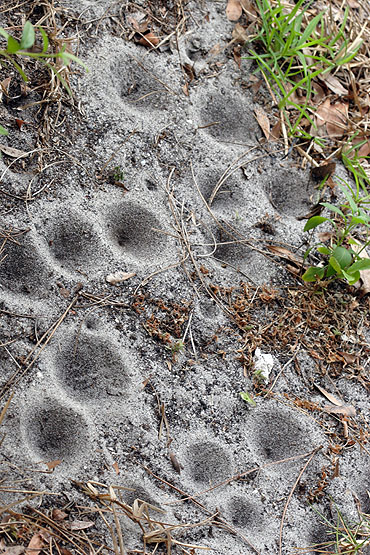
From the human vantage point, the ant lion minefield looks less menacing. Each pit conceals a larva at the bottom.

photo details (attack series): Canon 100mm f2.8 macro lens on a Canon EOS 50D
ISO 100, 1/250 sec, f9.0, 550EX flash off-camera behind pit
(larval portrait): Canon MP-E 65mm 1-5x macro lens on a Canon EOS 50D
all photos except adult ant lion taken at the Archbold Biological Station in Florida;
the adult was photographed  in California using a Canon EOS D60

Like this:

Like
Be the first to like this post.

Posted in Ants, Nature, Science | Tagged ant lion, antlion, ecology, myrmeleontidae, neuroptera, Photography, predation, sand | 16 Comments

16 Responses

  1. on June 23, 2009 at 6:32 am homebuggarden

    Science fiction and horror have nothing on the real, everyday world at ground level. Nice set of images. Thanks.


  2. on June 23, 2009 at 6:40 am ViktoryiaN

    Wow! Very cool photos! How much time did it take to capture those moments?


  3. on June 23, 2009 at 7:25 am Jessica

    Amazing photos!


  4. on June 23, 2009 at 7:41 am Adrian Thysse

    Thanks Alex, amazing indeed!


  5. on June 23, 2009 at 9:47 am Rodrigo Feitosa

    Wonderful!


  6. on June 23, 2009 at 9:56 am Kirk

    Ah! Brings back memories of childhood, tossing ants into the pits…


  7. on June 24, 2009 at 4:15 am nopoles

    Sometimes Hymenoptera may have their revenge (:
    http://www.helsinki.fi/~mkolkkal/leijona/loisolento.html
    (an antlion’s parasitoid in action)


  8. on June 24, 2009 at 5:05 am Great Antlion resources

    [...] research.  Today, I’ve run across two excellent photo resources on antlions.  One at the Mymercos Blog has exceptional images of and antlion in action and the other introduced me to Mikko [...]


  9. on June 24, 2009 at 3:32 pm myrmecos

    nopoles- wow, that’s amazing! Thanks for sharing the link.


  10. on June 24, 2009 at 5:26 pm ant -looka- atta

    I have grown to love ants as well as seeds
    Is the ant a species of Camponotus?

    Thanks Alex for Jo’s photo
    I used to work with Jo when she worked @ Wacol


  11. on June 25, 2009 at 6:03 am Olivier

    Great work !

    I see you have some french friends : http://www.linternaute.com/science/biologie/photo/l-univers-microscopique-des-fourmis/l-univers-microscopique-des-fourmis.shtml


  12. on June 29, 2009 at 6:43 pm mfb

    Fantastic!


  13. on July 2, 2009 at 4:50 am hape

    我會做螞蟻 用編織ㄉ


  14. on July 16, 2009 at 5:17 pm Luke Wade

    So cool…

    Surely this is the inspiration for the sarlaac pit in Starwars..?

    heheh


  15. on July 20, 2009 at 2:00 pm It’s a Trap! Amazing Ambushes from the Macroscopic Universe

    [...] Antlion Vs Ant Photo: Alex Wild [...]


    • on July 22, 2009 at 6:15 pm Luke Wade

      Heheh, cool. Thanks.


Comments are closed.


  • This blog is an archive; the Myrmecos blog has moved.

    Please update your bookmarks!
  • Alex’s Galleries

    alexanderwild.com

  • Recent Photos

    A hover fly sits on its perch.

Urbana, Illinois, USA

    Phyllocrania paradoxa, the ghost mantis, is an African insect that has become common in the pet trade.

    A worker honey bee visits a dandelion blossom.

Urbana, Illinois, USA

    Portrait of an eastern ant cricket, Myrmecophilus pergandei.

Urbana, Illinois, USA

    The eastern ant cricket, Myrmecophilus pergandei, lives in ant nests where it steals resources from their hosts.

Urbana, Illinois, USA

    The eastern ant cricket, Myrmecophilus pergandei, lives in ant nests where it steals resources from their hosts.

Urbana, Illinois, USA

    More Photos
  • Biology Links

    • Tree of Life
    • Understanding Evolution
  • Blogroll

    • Ainsley Vs Livejournal
    • Ammonite
    • Anna’s Bee World
    • Archetype
    • Arthropoda blog
    • Backyard Arthropod Project
    • Beetles in the Bush
    • biodiversity in focus
    • Bug Dreams
    • Bug Eric
    • Bug Girl’s Blog
    • Burrard-Lucas Photoblog
    • Catalogue of Organisms
    • Creature Cast
    • Dan Heller
    • Debbie's Insect Blog
    • Dechronization
    • Drawing the MotMot
    • Entomoblog
    • Evolving Thoughts
    • Fall to Climb
    • Generant
    • Historias de Hormigas
    • Life on Six Legs
    • Macromite
    • microecos
    • mirmekolozi
    • myrmecoid
    • Myrmician
    • Natural Imagery
    • Nature in the Ozarks
    • NCSU Insect Blog
    • No Cropping Zone
    • omit needless words
    • Photo Synthesis
    • Princess Peppercloud
    • Science Blogs
    • Snail’s Tales
    • Stu Jenks
    • The Ant Hunter
    • The Ant Room
    • The Bug Whisperer
    • The Loom
    • This Week in Evolution
    • What's Bugging You?
    • Wild about Ants
    • Xenogere
  • Insect Links

    • Ant Farm Forum
    • Ant Insights
    • Antweb
    • Bug Squad
    • bugguide.net
    • Xerces Society
  • Photography Links

    • Canon Photography Forums
    • Digital Photography Review
    • DIY Photography
    • Igor Siwanowicz
    • Mark Plonsky
    • photo.net
    • Piotr Naskrecki
    • The Strobist
  • Popular Posts

    • How to Identify the Argentine Ant, Linepithema humile
    • How to Identify Queen Ants
    • CombineZP: stack your images for free
    • The best insect photos of 2009
    • Rover Ants (Brachymyrmex patagonicus), an emerging pest species
    • The World's Largest Ants...
    • The Canon MP-E 65mm 1-5x Macro Lens
    • Ant Metamorphosis
    • Friday Beetle Blogging: Palo Verde Beetle
    • Beware the Cow-Killer
  • Recent Posts

    • This blog has moved.
    • Friday Beetle Blogging: The Hollyhock Weevil
    • The Friday Beetle will be late…
    • Bed bugs reach an all-time high
    • Answer to the Monday Night Mystery
  • Recent Comments

    • John Hohttp://www.pbase.com/skhin/image/143573254 on About Alex Wild
    • Donald Byron Johnson on Reader question: who discovered the sex of ant workers?
    • Anonymous on Update on the Rogue Taxonomist
    • Ant on Arizona Daily Star covers “Planet of the Ants”
    • Ga. Girl on Beware the Cow-Killer
  • Categories

  • Archives

  • Tags

    animation Ants aphids Argentina art Bees beetles biodiversity biology Biology Links bugs carabidae coleoptera diptera E. O. Wilson ecology entomology Evolution fail fire ants Flies formicidae Insects invasive species macro macrophotography miniscule music myrmecology natural history Nature new species Parasites pheidole Photography Photography business phylogenetics phylogeny Pogonomyrmex politics predation social insects Taxonomy termites wasps
  • Nature Blog Network

    Add to Technorati Favorites


    Follow this blog

Blog at WordPress.com.

Theme: MistyLook by Sadish.


Follow

Get every new post delivered to your Inbox.

Join 59 other followers

Powered by WordPress.com