• Home
  • About Alex Wild
  • Articles
  • Galleries
  • Myrmecology News

Myrmecos Blog

the little things matter

Feeds:
Posts
Comments
« And now, a cockroach
Introducing a Guide to the Ants of North America »

Friday Beetle Blogging: A mealworm comes of age

March 26, 2010 by myrmecos

Tenebrio molitor, pupa

Tenebrio molitor is a darkling beetle known more for its immature stages than for its adults. It is the ubiquitous mealworm. You can buy these granivorous beetles at any pet store as food for fish, birds, and reptiles.

The above shot of a developing pupa requires two sources of light. A flash head positioned behind the insect backlights the subject to produce the translucent glow. A second, positioned above and in front, is powered down and provides the highlights and details of the head and appendages.
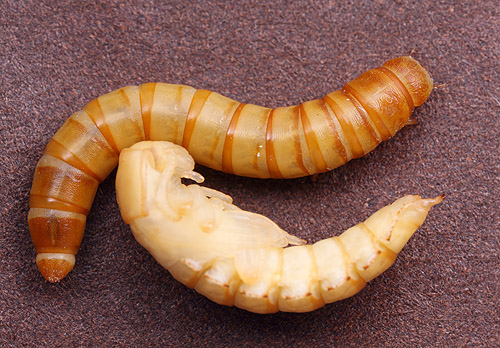
Tenebrio molitor larva and pupa

Stronger backlighting gives this shot more glow

Photo details: Canon MP-E 65mm 1-5x macro lens on a Canon EOS 50D
ISO 100, f13, 1/40-1/250  sec

Like this:

Like Loading...

Posted in beetles, Nature | Tagged Insects, metamorphosis, Photography, tenebrio | 16 Comments

16 Responses

  1. on March 26, 2010 at 7:55 am Kurt

    I love your blog. I get to learn not just about insects but also photography/lighting at the same time!


    • on March 26, 2010 at 8:43 am myrmecos

      Thanks, Kurt! That’s very kind of you to say so.


  2. on March 26, 2010 at 8:24 am Deaf Indian Muslim Anarchist

    very beautiful


  3. on March 26, 2010 at 9:09 am allthingsbiological

    The craftsmanship of photography really becomes apparent in this entry. Each image is spectacular. Maybe you should speak with the university about offering a biological photography class in addition to the beekeeping class this summer. Alternatively, you could offer a photography class for educators broadly across the K-16 spectrum.

    In the wake of the recent financial recissions and the university-wide focus on rising in rankings as well as uniqueness of programming I think one of our gems remains undiscovered…


    • on March 26, 2010 at 9:16 am myrmecos

      Thanks Dave! We’re on it. Andy Suarez and I are planning an Insect Photography discovery class for the fall, although we’re still waiting for University approval. With any luck the budget cuts won’t torpedo the idea.


  4. on March 26, 2010 at 10:05 am Ted C. MacRae

    Awesome. Are you using extenders for the ring flash heads or a different strobe unit?


    • on March 26, 2010 at 10:11 am myrmecos

      I’ve got the camera on a tripod. My hands are then freed to move the MT-24EX flash heads about as needed.


      • on March 26, 2010 at 11:18 am Ted C. MacRae

        Then you press the shutter release with your third hand? :)

        That does it – I’ve got to get a tripod.


      • on March 26, 2010 at 7:15 pm peteryeeles

        Ted,

        Check these out:

        http://www.patersonphotographic.com/benbo-tripods.htm

        Best thing since sliced bread for natural light macro work. Bit fiddly as a regular tripod, but they are so versatile I put up with it.


      • on March 26, 2010 at 7:23 pm Ted C. MacRae

        Would you suggest the Benbo Mini Trekker?


      • on March 26, 2010 at 10:05 pm peteryeeles

        I use the regular Trekker, because I wanted the height for taking straight down photos of quadrats. Not seen the mini, so can’t really comment.

        Found a review of a uni-loc, which is a different brand of basically the same product.

        http://forums.dpreview.com/forums/read.asp?forum=1034&message=11688125

        Loved his comment “like teaching a drunken octopus to play bagpipes”!!


  5. on March 26, 2010 at 1:15 pm Kenneth McFarlane

    I’m well familiar with these guys, as I breed them for my reptiles and spiders.
    I’ve always thought the pupae were nifty looking, but you make them darned glamorous.
    Really enjoying these segments for both the images and the education. Rock on.


  6. on March 26, 2010 at 4:33 pm Charlos

    Ahh, they’re so cute at that age!


  7. on March 26, 2010 at 7:16 pm peteryeeles

    That first shot is a cracker; the details in the developing exoskeleton are superb.

    Something about it reminds me of the film Alien…


  8. on March 26, 2010 at 10:21 pm kurt

    I forgot to ask – do you need a snoot to point the light at the back of the pupa, to prevent light spill and glare in the image?

    I have totally zero experience with more than one artificial light sources. Thanks :)


  9. on March 31, 2010 at 1:13 am Marvin

    Hummm. Evidently the totally unknown (to me) critter I found in the soil this afternoon might be some kind of beetle pupa.

    Awesome photos!


Comments are closed.


  • This blog is an archive; the Myrmecos blog has moved.

    Please update your bookmarks!
  • Alex’s Galleries

    alexanderwild.com

  • Recent Photos

    A Halictus ligatus sweat bee covered in Rudbeckia pollen, which the bee gathers to feed to her larvae.

Urbana, Illinois, USA

    A small Lasioglossum sweat bee gathers pollen from an aster. Native bees are more important pollinators of prairie plants than the better-known domestic honey bees.

Urbana, Illinois, USA

    Toxomerus marginatus (Syrphidae) - hover fly visiting a spiderwort flower.

Urbana, Illinois, USA

    ALasioglossum bee returns to her soil nest laden with pollen.

Urbana, Illinois, USA

    A soil-nesting Lasioglossum bee (Halictidae) peers out of her burrow.

Urbana, Illinois, USA

    Drosophila melanogaster, a white eyed mutant fruit fly used for genetics research.

Laboratory stock at the University of California, San Diego

    More Photos
  • Biology Links

    • Tree of Life
    • Understanding Evolution
  • Blogroll

    • Ainsley Vs Livejournal
    • Ammonite
    • Anna’s Bee World
    • Archetype
    • Arthropoda blog
    • Backyard Arthropod Project
    • Beetles in the Bush
    • biodiversity in focus
    • Bug Dreams
    • Bug Eric
    • Bug Girl’s Blog
    • Burrard-Lucas Photoblog
    • Catalogue of Organisms
    • Creature Cast
    • Dan Heller
    • Debbie's Insect Blog
    • Dechronization
    • Drawing the MotMot
    • Entomoblog
    • Evolving Thoughts
    • Fall to Climb
    • Generant
    • Historias de Hormigas
    • Life on Six Legs
    • Macromite
    • microecos
    • mirmekolozi
    • myrmecoid
    • Myrmician
    • Natural Imagery
    • Nature in the Ozarks
    • NCSU Insect Blog
    • No Cropping Zone
    • omit needless words
    • Photo Synthesis
    • Princess Peppercloud
    • Science Blogs
    • Snail’s Tales
    • Stu Jenks
    • The Ant Hunter
    • The Ant Room
    • The Bug Whisperer
    • The Loom
    • This Week in Evolution
    • What's Bugging You?
    • Wild about Ants
    • Xenogere
  • Insect Links

    • Ant Farm Forum
    • Ant Insights
    • Antweb
    • Bug Squad
    • bugguide.net
    • Xerces Society
  • Photography Links

    • Canon Photography Forums
    • Digital Photography Review
    • DIY Photography
    • Igor Siwanowicz
    • Mark Plonsky
    • photo.net
    • Piotr Naskrecki
    • The Strobist
  • Popular Posts

    • How to Identify Queen Ants
    • Rover Ants (Brachymyrmex patagonicus), an emerging pest species
    • How to Identify the Argentine Ant, Linepithema humile
    • Beware the Cow-Killer
    • CombineZP: stack your images for free
    • The World's Largest Ants...
    • The Canon MP-E 65mm 1-5x Macro Lens
    • Friday Beetle Blogging: Palo Verde Beetle
    • The Best of Myrmecos 2009
    • An Ant Lion in Action
  • Recent Posts

    • This blog has moved.
    • Friday Beetle Blogging: The Hollyhock Weevil
    • The Friday Beetle will be late…
    • Bed bugs reach an all-time high
    • Answer to the Monday Night Mystery
  • Recent Comments

    • how much do social workers make a year in texas on About Alex Wild
    • John Hohttp://www.pbase.com/skhin/image/143573254 on About Alex Wild
    • Donald Byron Johnson on Reader question: who discovered the sex of ant workers?
    • Anonymous on Update on the Rogue Taxonomist
    • Ant on Arizona Daily Star covers “Planet of the Ants”
  • Categories

  • Archives

  • Tags

    animation Ants aphids Argentina art Bees beetles biodiversity biology Biology Links bugs carabidae coleoptera diptera E. O. Wilson ecology entomology Evolution fail fire ants Flies formicidae Insects invasive species macro macrophotography miniscule music myrmecology natural history Nature new species Parasites pheidole Photography Photography business phylogenetics phylogeny Pogonomyrmex politics predation social insects Taxonomy termites wasps
  • Nature Blog Network

    Add to Technorati Favorites


    Follow this blog

Blog at WordPress.com.

Theme: MistyLook by WPThemes.


Follow

Get every new post delivered to your Inbox.

Join 64 other followers

Powered by WordPress.com
%d bloggers like this: