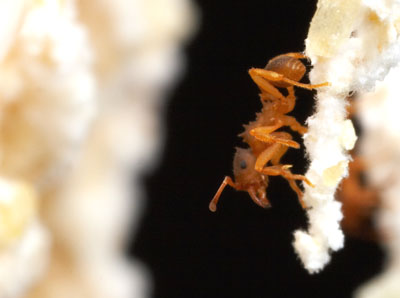
An exciting week for ant aficionados! A new study by ant phylogenetics gurus Ted Schultz and Seán Brady provides the first detailed picture of attine evolution. These New World ants have long attracted the attention of biologists because they, like our own species, practice a well-developed form of agriculture. Instead of plants, these ants grow fungi, and their relationship is so specialized that the ants can consume nothing else. Schultz and Brady use data from four nuclear genes, the fossil record, and the biology of extant ants to infer an evolutionary history for 65 attine species. I’ve distilled their results (with the help of Mesquite) into a summary figure:

The basic picture is that the fungus-ant mutualism arose about 50 million years ago in a relatively generalized form. As we can see from the above tree, a great many attine lineages persist in this basic sort of system, allowing us to conclude with some confidence what the early attines were like. Species that practice this ‘lower’ agriculture (in Shultz and Brady’s words) have small colonies, often with no more than a few dozen ants, and they cultivate a wide range of different fungi in the Leucocoprineae. These fungi, as far as anyone can tell, are capable of a free-living existence when not hanging around in ant nests. The ants maintain their cultivars on a diet of vegetable debris and insect droppings.


‘Lower’ Agriculture: one meter underground, a golf-ball sized fungus garden of Mycetosoritis

‘Lower’ Agriculture: Mycetosoritis in the fungus garden
For the first 30 million years of ant agriculture, nothing all that significant happened. At least, not that we can tell from the available evidence. About 20 million years ago, spurred by who knows what, several interesting variations on the agricultural system appeared. A lineage of the graceful and leggy Apterostigma domesticated a completely unrelated coral fungus. A lineage of chunky little Cyphomyrmex started cultivating their fungus in yeast form. Perhaps most fatefully, one group of fungus lost its ability to live free of ant nests and started producing specialized food bodies for the ants’ consumption. This latter event spawned a series of “higher” agriculture systems.

The yeast garden of Cyphomyrmex rimosus on a substrate of caterpillar frass

‘Higher’ Agriculture: Trachymyrmex desertorum

‘Higher’ Agriculture: Sericomyrmex
The attines most familiar to us are the leafcutter ants of the tropics and subtropics. Their fungus has developed a taste for fresh wet vegetation, and the ants’ efforts to feed their ravenous cultivar are the stuff of legend. Mature Atta colonies contain millions of individuals and can defoliate entire trees overnight. Farmers despise them, naturalists sit and watch their busy trails for hours on end; they are dominant animals. They are also surprisingly recent. According to Schultz and Brady, the first leafcutters didn’t appear until about 10 million years ago, emerging from within the “higher” agriculture genus Trachymyrmex.

Leafcutter Agriculture: Acromyrmex coronatus

Leafcutter Agriculture: Atta cephalotes. The white substance
is the cultivated fungus, seen here digesting leaf matter.
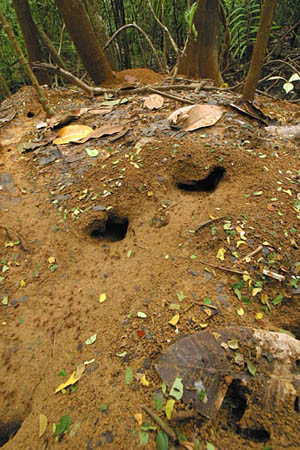
Leafcutter Agriculture: external structure of a massive Atta nest
While all this is absolutely fascinating biology, the taxonomist in me cringes. The repeated pattern of specialized lineages evolving from within less specialized groups has created a taxonomist’s perfect storm. Each new innovation leaves behind a paraphyletic assemblage of species with the earlier, primitive traits. These earlier groups have none of the unique derived states required to establish a stable classification. As a consequence, the taxonomy of the attines will have to undergo a major upheaval.
In particular, don’t get too attached to the following paraphyletic genera: Trachymyrmex, Cyphomyrmex, Mycetosoritis, and Mycetophylax. Safe, for now, are Apterostigma, Mycetarotes, Mycocepurus, Myrmicocrypta, Acromyrmex, and Atta. I don’t envy whoever sits down to sort out the traditional taxonomic scheme along more evolutionary lines.
Source: Schultz, T.R., Brady, S.G. 2008. . PNAS Early Edition 10.1073/pnas.0711024105
Amazing video of a massive leafcutter nest
Leafcutter ant image gallery
Lurker’s guide to leafcutter ants
ScienceDaily coverage of the attine phylogeny


 Myrmecos Blog
I was wondering if you’d hit this article today. I’m going to post on it this evening and will send you a trackback. Great pictures, and you certainly know a lot more about ants than I ever will!
Thanks Nimravid! Feel free to use these figures in your post.
[…] Wild at Myrmecos also covered this article today, and includes photographs of various attine ants and their […]
I think it’s fascinating that these ‘fungus growing ants’ live in colonies of usually only a few dozen. Like little groups of farmers or something. Interesting read, thanks for the information and photos……
I, for one, welcome our new ant overlords…
^^^LOL at above comment…
Anyway great blog dude, I have to say that those are some amazing pics of ants (always watched them whenever they were on during animal planet or discovery channel)
Keep up the great work!
pkay.
Yeah, the leafcutters, and especially the Atta sp. are most likely very recent additions. For one thing, they all freaking look alike, with minor variations. Sometimes I wonder what the future leafcutters will look like, millions of more years in front.
Instructive indeed
I always thought Cyphomyrmex was one of the most primitive Attine ants. Not only this is far to be the case, but this *genus” is a thee-fold paraphylum vs Trachymyrmex (itself a paraphylum) and the two Leaf-cutters.
Establishing a phylogenetic classification based on these results will (or, to put it in a more realistic way, would) be quite a HARD work, as you imply.
[…] answer is understandable in light of the distinct pattern of evolution among the fungus growing ants, revealed in a 2008 study by Ted Schultz and Sean Brady: Simplified […]
I live in Trinidad and grew up in a house with a yard full off these, we cal them bachaks here and people generally don’t bother them. They bite very hard and they favour mango leaves, they also make pathways in the grass between the nest and the tree.