• Home
  • About Alex Wild
  • Articles
  • Galleries
  • Myrmecology News

Myrmecos Blog

the little things matter

Feeds:
Posts
Comments
« Spider 1, Bird 0
Friday Beetle Blogging: Dogbane Leaf Beetle »

Dracula Ants at Myrmecos.net

October 22, 2008 by myrmecos

Adetomyrma sp. “mad-01″, larvae and adults
Madagascar

With a name like “dracula ant” you’d think these waspy little Adetomyrma might suddenly lunge for your jugular.  But they are shy creatures, drinking not the blood of hapless victims but sparingly from the hemolymph of their own larvae.  It’s an odd behavior, yet one that makes a certain amount of sense when considering the haphazard way that evolution works.

Here’s the problem: ants have a skinny little waist through which their digestive tract must pass. Solid food would lodge in the bottleneck and kill the ant, so the ants can’t eat solids. They can only drink.

Yet, in forgoing solid food ants miss out on all sorts of protein available in the environment.  Ants must either give up protein or figure out how to convert solids into drinkable juice. That’s where the larvae come in.

Larvae are made to eat and can handle all manner of food.  They consume the solids that the worker ants have brought back to the nest and, after a little digestion, pass the protein back as a liquid.  Most ant species have a simple, elegant way to do this: they regurgitate for the adults when prompted.  But this direct food-passing behavior only appears in the more recent ant lineages.  The ancient subfamily Amblyoponinae- including Adetomyrma- diverged from the rest of the ants over 100 million years ago and couldn’t inherit this sensible way of doing things.

Natural selection is a blind process.  Evolution often solves problems with unexpected, rube-goldberg solutions that any reasonable designer would never implement, and the Amblyoponines happened on one of those odd solutions.  They found a more morbid way to get at all those larval proteins.  The adult ants just chew a hole in the larval skin.  The hemolymph oozes out, and the adults take a drink.

It’s a bit brutish, and the larvae bear scars, but it doesn’t seem to cause long term harm.  It’s apparently just part of how larvae contribute back to the colony that feeds them.
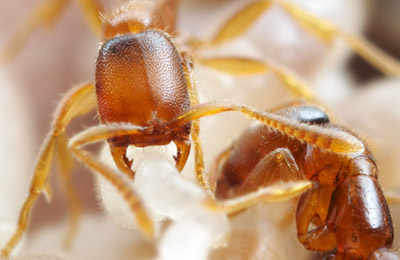
In any case, a while back myrmecologist Brian Fisher loaned me a captive colony of his beloved Adetomyrma from Madagascar.  These ants were first discovered less than 20 years ago- the species pictured here still lacks a formal scientific name- and the genus remains one of the rarest and least understood of all ants.  It was a real treat to get my hands on such an oddity, and I’ve uploaded the new photos here:

Adetomyrma at myrmecos.net

postscript: If you’d like to see live Dracula Ants, there’s no need to travel all the way to Madagascar.  The centipede predator Amblyopone pallipes is widespread in North America and can be found in rotting wood and under stones in forested habitats.

Like this:

Like
Be the first to like this post.

Posted in Ants, Insect Links, Photography Links, Science | Tagged Adetomyrma, entomology, Evolution | 3 Comments

3 Responses

  1. on October 31, 2008 at 11:15 pm Marvin

    Interesting.


  2. on June 22, 2009 at 7:52 am mental_floss Blog » The Brutal Lives of 6 Scary Ant Species

    [...] of other insects tothe colony. The larvae, which are larger than adult ants, eat the prey and digest the protein into liquid form, which the adults feed on in the form of larval blood. The entire genus is [...]


  3. on February 5, 2010 at 6:06 am Ants invade Beetles in the Bush! « Beetles In The Bush

    [...] flesh of prey lapped up from the larva’s messy eating.  In some lineages, known as Dracula ants, adults actually “bleed” the larvae through rapidly healing wounds made at particular [...]


Comments are closed.


  • This blog is an archive; the Myrmecos blog has moved.

    Please update your bookmarks!
  • Alex’s Galleries

    alexanderwild.com

  • Recent Photos

    A hover fly sits on its perch.

Urbana, Illinois, USA

    Phyllocrania paradoxa, the ghost mantis, is an African insect that has become common in the pet trade.

    A worker honey bee visits a dandelion blossom.

Urbana, Illinois, USA

    Portrait of an eastern ant cricket, Myrmecophilus pergandei.

Urbana, Illinois, USA

    The eastern ant cricket, Myrmecophilus pergandei, lives in ant nests where it steals resources from their hosts.

Urbana, Illinois, USA

    The eastern ant cricket, Myrmecophilus pergandei, lives in ant nests where it steals resources from their hosts.

Urbana, Illinois, USA

    More Photos
  • Biology Links

    • Tree of Life
    • Understanding Evolution
  • Blogroll

    • Ainsley Vs Livejournal
    • Ammonite
    • Anna’s Bee World
    • Archetype
    • Arthropoda blog
    • Backyard Arthropod Project
    • Beetles in the Bush
    • biodiversity in focus
    • Bug Dreams
    • Bug Eric
    • Bug Girl’s Blog
    • Burrard-Lucas Photoblog
    • Catalogue of Organisms
    • Creature Cast
    • Dan Heller
    • Debbie's Insect Blog
    • Dechronization
    • Drawing the MotMot
    • Entomoblog
    • Evolving Thoughts
    • Fall to Climb
    • Generant
    • Historias de Hormigas
    • Life on Six Legs
    • Macromite
    • microecos
    • mirmekolozi
    • myrmecoid
    • Myrmician
    • Natural Imagery
    • Nature in the Ozarks
    • NCSU Insect Blog
    • No Cropping Zone
    • omit needless words
    • Photo Synthesis
    • Princess Peppercloud
    • Science Blogs
    • Snail’s Tales
    • Stu Jenks
    • The Ant Hunter
    • The Ant Room
    • The Bug Whisperer
    • The Loom
    • This Week in Evolution
    • What's Bugging You?
    • Wild about Ants
    • Xenogere
  • Insect Links

    • Ant Farm Forum
    • Ant Insights
    • Antweb
    • Bug Squad
    • bugguide.net
    • Xerces Society
  • Photography Links

    • Canon Photography Forums
    • Digital Photography Review
    • DIY Photography
    • Igor Siwanowicz
    • Mark Plonsky
    • photo.net
    • Piotr Naskrecki
    • The Strobist
  • Popular Posts

    • How to Identify the Argentine Ant, Linepithema humile
    • How to Identify Queen Ants
    • CombineZP: stack your images for free
    • The best insect photos of 2009
    • Rover Ants (Brachymyrmex patagonicus), an emerging pest species
    • The World's Largest Ants...
    • The Canon MP-E 65mm 1-5x Macro Lens
    • Ant Metamorphosis
    • Friday Beetle Blogging: Palo Verde Beetle
    • Beware the Cow-Killer
  • Recent Posts

    • This blog has moved.
    • Friday Beetle Blogging: The Hollyhock Weevil
    • The Friday Beetle will be late…
    • Bed bugs reach an all-time high
    • Answer to the Monday Night Mystery
  • Recent Comments

    • John Hohttp://www.pbase.com/skhin/image/143573254 on About Alex Wild
    • Donald Byron Johnson on Reader question: who discovered the sex of ant workers?
    • Anonymous on Update on the Rogue Taxonomist
    • Ant on Arizona Daily Star covers “Planet of the Ants”
    • Ga. Girl on Beware the Cow-Killer
  • Categories

  • Archives

  • Tags

    animation Ants aphids Argentina art Bees beetles biodiversity biology Biology Links bugs carabidae coleoptera diptera E. O. Wilson ecology entomology Evolution fail fire ants Flies formicidae Insects invasive species macro macrophotography miniscule music myrmecology natural history Nature new species Parasites pheidole Photography Photography business phylogenetics phylogeny Pogonomyrmex politics predation social insects Taxonomy termites wasps
  • Nature Blog Network

    Add to Technorati Favorites


    Follow this blog

Blog at WordPress.com.

Theme: MistyLook by Sadish.


Follow

Get every new post delivered to your Inbox.

Join 59 other followers

Powered by WordPress.com